Information about work, life and play in Regional Australia

Thursday, October 19, 2006

Job Opportunities in Regional NSW

Question

What employment awaits me in NSW country? Frequently asked question.

Answer

There are a wide range of job opportunities, especially for professionals and skilled trades.

NSW country is currently experiencing shortages of skills in the following areas:
  • Skilled labour: mining and construction
  • Welders
  • Electricians
  • Fitters
  • Boilermakers
  • Engineers
  • Medical:Doctors and Radiographers
  • Accountants
  • Lawyers
  • Rehabilitation providers - Occupational therapist providers
  • Teachers

These are examples of roles that are in high demand. Other skills are also needed.

At the same time, country NSW is very diverse. This means that there are considerable variations between areas. So you need to investigate opportunities in the areas that you are interested in.

How do I find the job I want in NSW Country?

Question

How do I find the job I want in NSW country? Frequently asked question

Answer

There are two overlapping ways, depending on your preferences.

If you know where you would like to live, at least in broad terms, start by researching the region and town that best suits you. Most councils have their own web sites.

The council web sites will provide you with general information about an area and also often include links to the local newspaper. The newspaperļ¾ web sites often contain details of current advertised jobs.

While most councils do not provide job placement services as such, many councils (Taree, Dubbo and Tamworth are examples) do have some knowledge of key local skills needs. The starting point here is the Council's economic development officer or the local development corporation where this exists.

You should also contact employment agencies in the region regarding suitable roles. For example in some towns the shortage for a good boilermaker is such that one could walk into town in the morning and have a job before dinner!

Because relocation involves more than just a job, you should also plan a visit to the region. This will allow you to assess living conditions and talk to council and local businesses.

If you do not have a preferred region or are prepared to consider broader opportunities, then the annual Country Week Expo provides an excellent opportunity to find out about both job opportunities and life style across regional NSW. The Expo features stands from a wide variety of areas, with most council exhibitors having some form of job kit and associated job vacancy list.
Recognising that not all jobs are advertised, you can also check advertised vacancies in Rural Press Publications across regional Australia, not just NSW, by visiting http://www.jobsguide.com.au/. This allows you to search by job category or region or a combination.

Depending on your area, you should also check with the relevant professional or industry association to see what information they have. A number of these bodies do have details of job vacancies.

Real Estate and Getting Back to Sydney

Question

One thing that worries us about any move from Sydney is the fear that we will not be able to come back again simply because we will never be able to afford to buy here again. Worried professional, Balmain.

Answer

The starting point here is to do some research so that you know what your options are. For example, do you hold and rent the Sydney property, sell it and buy in the place you are going to, sell it and reinvest in part in Sydney, in part elsewhere?

The regional real estate marketplace is very diverse, just as diverse if not more so than Sydney.

In general, house prices are lower then Sydney, blocks often bigger. So it's possible to get a much bigger place with the same money. Things such as swimming pools or even tennis courts can be added. The real risk to avoid here is overcapitalisation, adding life style elements that cannot then be recovered from later sale.

It is also actually not true that Sydney real estate always appreciates faster than its country cousin in percentage terms, although the timing in appreciation cycles can be different. In regional NSW for example, country appreciation cycles often lag Sydney cycles. One reason for this is that Sydney money often goes bush once Sydney prices become too expensive and peak.

Another factor to consider is that the return on an investment property over time is a combination of rents and capital gains. Rental yield on regional properties are usually higher, often much higher, than the Sydney equivalent. This can make the apparently higher Sydney capital appreciation very misleading.

Because both rental and purchase markets vary so much across regional Australia, you do need to investigate. Do not, for example, buy something just because it appears incredibly cheap by Sydney standards. Sounds dumb, but a lot of people do.

Wednesday, October 18, 2006

Cars, Trains and Planes - how they affect our view of the world


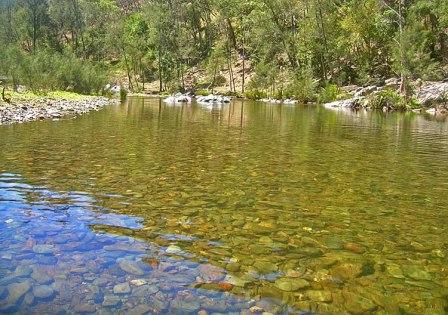
Photo: Gordon Smith, Styx River east of Armidale New England

Have you ever noticed how transport affects our view of the world?

I suppose that this first became really important with the train, the first fast mass transit technology. Not only was it fast, but it enabled people to ignore the world they were travelling through.

Cars and planes accelerated the process. Vast valleys that had once taken days or even weeks to cross suddenly became an hour or even minutes of travelling time.

This photo is one of a series of shots taken by Gordon Smith along the Styx River. Gordon felt that after walking 14 km, wading across the river 14 times, and 600m of ascent, the post-walk coffee and chocolate biscuits were well deserved!

Compare this with the view of the world created by modern transport. The entire Styx river simply disappears.

I am not knocking modern transport. The story on some of the attractions around Wagga Wagga, a case study showing a small slice of the opportunities offered by Regional Australia, was all based on the car. But sometimes it's nice to look small.

There is enormous variety in the Australian countryside, variety that can really only be seen if you stop and look.

Maybe I'm old fashioned, but it sometimes worries me that we seem to be creating a generation of children whose only knowledge of the country side comes from obligatory school excursions now increasingly preceded by information sessions warning parents of dangers and intended to protect schools and organisers from legal risk through a process of "informed consent."

Tuesday, October 17, 2006

Statement of Editorial Policy

I am carrying this statement on each of my blogs.

There has recently been a fair bit of discussion (here, here, here and here, for example) about problems and issues associated with blogging.

I publish and mainly write four blogs, each serving a different purpose. In doing so, I try to be accurate. However, recently I made some mistakes of fact and interpretation in a story. They were pointed out to me and I have corrected them.

This case provided an excellent illustration of the need for care. I thought therefore that I should provide a statement of principles governing my approach to all my blogs. Each blogger has their own approach. This is mine.

All my blogs are intended to stimulate interest in and discussion on particular topics. They provide an opportunity for me to place ideas, thoughts, information and research on the public record. I spend a fair bit of time thinking about individual stories and want my readers to value the visit experience. I also believe that blogs are a way of encouraging civilised conversation. To this end:

  1. All my blogs contain a mix of fact, analysis, recollection and opinion.
  2. I try to check my facts. However, I will make mistakes. Where I do so, I will make corrections to the story and, if necessary, acknowledge the mistake.
  3. There will also be mistakes in my analysis. Again, I am happy to recognise and discuss such errors.
  4. While I try to be objective, I recognise that my own values and opinions colour my writing. I will try to write in such a way that the reader can properly indentify my views and biases and hence make their own judgments. This holds especially when I am arguing a case.
  5. When writing as an analyst, I try to deconstruct the elements in a discussion so that I can properly present issues and approaches. I will try to do so independent of personalities.
  6. Since I want to encourage civilised conversation, I will try to treat my visitors with courtesy even where I disagree with them. I reserve the right to delete comments where those comments are nasty or may create legal problems, but I will never delete a comment just because I disagree with it.
  7. As part of civilised conversation, I will try to recognise other's ideas, to contribute to relevant discussion on other people's blogs and to answer promptly emails arising from my blogs.

Monday, October 16, 2006

Festivals in Regional Australia


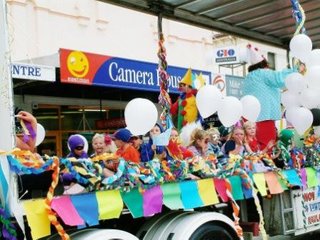
Photo: Land of the Beardies Festival, children's float

On the New England Australia blog I carried a story about the Land of the Beardies Festival to be held this year from 3 to 12 November. That story reminded me about one of the things I most love about Regional Australia living, the local festivals.

The festivals have different themes, but generally follow a common format. There is nearly always a procession and a major following event, usually held at the local showground. Around that are grouped a number of activities.

The whole thing is, quite simply, fun. Planning is carried out by local committees, very few regional festivals can afford staff, and begins immediately after the previous festival. Outcomes and activities are reviewed, and a plan developed.

The following months are then spent developing detailed action plans. Activity steps up as the date approaches. Venues and visiting artists have to be confirmed, volunteers and PR organised, programs printed.

The final weeks before the launch become a mad round of action. Things go wrong, tempers' fray, will we get there?

Launch day dawns. Regional Australians are generally good organisers, so much is done locally, that things generally work out. Still, there is always chaos at the start of the procession.

Even a small procession can stretch for several blocks from the start of the marshall point. People have to be told where to go, missing floats found, bands briefed. The whole thing is a major design exercise. Then start, the crowd lining the street, people clapping and yelling out comments, sweets thrown to the kids, kids running out into the road. Chaos but fun.

And then it's all over for another year.

Sunday, October 15, 2006

Australian Regional Food - Looking Back 2: The Home Garden

The home garden that used to be common in both city and country has been in sad decline, especially in city areas where density living and small block sizes make gardening more difficult. The gardening folk memories that we used to absorb from our parents have also declined.

While common in city and country, the home garden was especially important in regional areas simply because alternative supplies of fruit and vegetables were then not so readily available and could be expensive.

The CWA (Country Women's Association) cookery book puts it this way

"Home is not a Home without a garden. Plant one, and it will repay you.

Every wise housewife knows the value of the kitchen garden. It is a money saver, and a pleasure at all times. Nearly all vegetables are of easy culture. All soup vegetables should be grown at home. It is a great comfort to slip out and cut your own home requirements in your own back yard."


A reasonable size home garden could be quite a complex operation. Herbs - lavender, thyme, marjoram, mint, sage, parsley and rosemary were usually grown near the back door so that they could be easily picked for domestic purposes.

Further out were the vegetables grown in cycles depending on the growing season. Standard vegetables included onions, carrots, potatoes, peas and beans, sweet corn, pumpkins, lettuce, sometimes garlic although its use was then less common, cabbages, cauliflower, tomatoes, lettuce, silver beet, beetroot, parsnips and turnips. The compost heap could normally be found near the vegetable garden.

The garden nearly always included vines and fruit trees, with the mix varying depending on the climate. In the case of our home garden - a cool climate garden - there was the ubiquitous grape vine, three apricot trees, a rather superb plum tree, a fig tree, gooseberries, red and black currants, strawberries and raspberries.

Many gardens also contained a chook yard providing fresh eggs and the sometimes fowl for dinner. The manure from the yard was collected and used to fertilise the beds.

Then there were the flowers grown both for decoration and to supply cut flowers to the house.

The importance of the home garden, limitations in other supplies from outside the district, meant that the seasons were important.

As children we knew every fruit tree in the immediate area, knew when they were coming into fruit. No problem in getting children to eat fruit. Somehow fruit that we picked ourselves was just that much more satisfying.

The fruiting season for fruit and vegetables flowed into the bottling ritual. The bottles were sterilised, the fruit cooked, the tomato relish made, the jams created, providing a steady stream of produce for the rest of the year.

The exact mix of meals depended on what was available. Soups, stews and casseroles were common because these made best use of available produce. I still love the taste of fresh field mushrooms, of rich casserole sauce.

The standard meal was two courses, three for bigger meals. The main dish consisted of a meat dish presented in different ways usually with two to three vegetables. This was followed by a desert often of bottled fruit, sometimes with fresh cream. In some cases soup preceded the main meal.

There was great variety in home made soups. Some soups like chicken, often made from the remains of a bird previously killed, were relatively light, as were the broths served to invalids. Some soups were major meals in their own right served with crusty bread.

From a kid's perspective, one of the greatest things about the home garden was the way it provided trees to climb, places to hide, spots to dig in or to build camp fires.

We were expert in fires, how to start them in the best way, how to build fireplaces. Potatoes cooked in the ashes were eaten, charcoal and all, with butter with the melting butter running down fingers. Nostalgia!

Saturday, October 14, 2006

Australian Regional Food - Looking Back 1


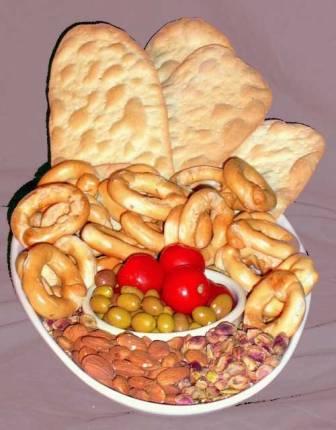
Photo: Serving suggestions, Bacco's Bakery, Murrurundi

I found Bacco's bakery through , the Australian Regional Food Guide, one of my regular reads. Founded by Kristy and Luigi Papagni, the bakery hand makes a savoury and sweet range of artisan products.

Australian cooking has changed enormously in recent years. Many of the changes are good, some not. Past menus may have had less variety, but they were also more balanced.

Today so much of what we eat is delivered from around the world to the supermarket door. This has its risks (see the story on the US spinach for example), may not always give us the best tasting food, but does provide a year-round variety that was once simply not available. We also take refrigeration for granted. And we are obsessed with saving time.

So what we eat, how we prepare it, how we serve it, has changed. Peas used to be much more popular than beans, with a shelling a family ritual, the kids eating the peas as they went along. Now fresh peas can be hard to find simply because of the preparation time involved.

The connection between diet and changing seasons has been largely broken. Yes there is a new emphasis on fresh seasonal produce, but the pattern of seasonal change is no longer built into the annual eating cycle.

Because so much has changed, I thought that it might be of interest if I looked back from time to time at past food experiences in Regional Australia, drawing among other things from my own experiences, the New Goulburn Cook Book (27th edition 1937), the CWA Cookery Book and Household Hints (36th edition, 1974) as well as Geoffrey Blainey's Black Kettle and Full Moon (Penguin Books, 2004). Subtitled "Daily life in a vanished Australia", the book is just that, an exploration of daily life up to the First World War.

This post is just to set the scene.

Friday, October 13, 2006

Cultural Activities in Regional Australia - information sources 2


This post follows up my earlier post on information sources relevant to cultural activities in Regional Australia.

Transformations is an electronic journal dedicated to the exploration of ideas, issues and debates emerging out of contemporary global culture. I mention it because it has some interesting articles on the Australian regional experience spread over several issues.

As mentioned before, Regional Arts Australia is a national body providing helpful information and tools for people involved as artists and arts workers in Regional Australia. It includes an online 'contact book' of regional artists and arts workers, to provide a mechanism for networking, sourcing of artists for contracts and projects, and for artists to make connections.

Festivals Australia is an Australian Government cultural funding program which provides assistance to Australian regional and community festivals for the presentation of quality cultural projects. Funding is available to add a new or special sort of cultural activity that has never been done before and could not otherwise be afforded. If you look at the details of past you will get a feel for the diversity of local and regional festivals.

Festivals Australia is a companion program to the new Festivals Australia Regional Residencies program. If you need support for an artist in residence to assist your community to tell a local story at a festival or major one-off community celebration, information on the Festivals Australia Regional Residencies program website may assist you.

Visions of Australia aims to enable more Australians to enjoy our diverse culture by accessing exhibitions of cultural material. It provides funding to eligible organisations to develop and tour exhibitions of Australian cultural material across Australia. Exhibitions should have a predominantly Australian source or theme.

The Commonwealth Government's Culture and Recreation Portal provides access to a range of information sources including a weekly updated news of what's on and what's coming up in the world of Australian culture and recreation. As a national site it does have a metro focus but does include information about activities in Regional Australia.

Tuesday, October 10, 2006

Seasonal Work in Regional Australia

Taking seasonal work such as fruit picking is one way of seeing Regional Australia while also being paid. Workabout Australia remains one of the best sites for seeking information about opportunities in this area.

If you are from another country, you must have a valid visa allowing you to work in Australia. In this context, the Australian Immigration Minister has recently warned regional employers to check if the people they are employing are legally entitled to work in Australia. (details).

Special arrangements apply to young people.

The Working Holiday and Work and Holiday Programmes provide opportunities for people between 18 and 30 from arrangement countries to holiday in Australia and to supplement their travel funds through incidental employment (details).