Information about work, life and play in Regional Australia

Showing posts with label Food. Show all posts

Wednesday, April 27, 2011

A frangourou in the New England countryside

Thus blog has been sadly neglected. It's not that I have lost my passion for the promotion of life outside Australia's metropolitan centres, more that the pressures of other writing and dSophie's eggsaily life intervened. This post marks the start of renewed posting.

French born Sophie Masson grew up in Sydney and now lives on a small block outside the university city of  Armidale. Sophie is a very successful Australian writer. Her new blog A la mode frangourou, subtitled a French Australian look at food, is an almost lyrical account of food and one version of regional living.

The photo shows her homegrown eggs. They look nice, don't they?     

Saturday, November 07, 2009

Derek Bullock's Camp Oven Cooking in Australia

Many modern Australians have forgotten how to cook outdoors. I was therefore pleased to discover that Derek Bullock's Camp Oven Cooking in Australia was keeping the old art of the camp oven alive.

Friday, November 16, 2007

Australia's Lobster Shortgage


Graphic: Western Rock Lobster Development Association

WA produces something like 80 per cent of Australia's lobster catch. The industry with its 500 boats justly prides itself on running an environmentally sustainable fishery.

This year the combination of economics with nature has worked against the industry. Rising fuel prices together with the rising Australian dollar has combined with a reduction in the projected catch from 10,500 to 9,400 tonnes to place pressure on the industry.

The loser? The Australian consumer who can expect to pay Christmas prices of $20 per piece as compared with $10 a few years ago.

Friday, June 01, 2007

Regional Australia food, olives and agriturismo

There have been a couple of recent posts on other blogs that brought together in my mind several themes that I have been writing about.

Over the last twelve months I have watched with pleasure the spread of bottles of Australian produced olive oil on Australian supermarket shelves.

As a story on the history of olive oil on olives101 reminds us, olives and olive oil have a long history. Yet in Australia the major use of olive oil is very recent. Growing up, olive oil was largely a medicinal product. Now it is something that I use all the time, a fundamental staple.

Olive oil production in Australia has a long history. But again until very recently, its production was very much a minor niche activity. Now olives and olive oil are produced in many parts of the country. Yet there is still a problem in all this.

On his rather wonderful View Italy blog, David Anderson writes a lot on the Italian regional experience, drawing out both the texture and variety of regional experience across the country. He also writes on agriturismo, essentially the way in which rural life is integrated into the regional experience.

The position in Australia is very different. In several posts on another blog we commented on some of the failings of Australian tourism at regional and local level.

A core failing is the failure to properly identify and build on the unique features of each location or region. For some reason, all areas try to promote general attributes that they feel will appeal.

Take farm stays. This is a very different concept to agriturismo as I understand the term. With farm stays you end up with a generic list all promoting experiencing farm life in some way. There is little focus on the unique life and experiences of the area.

Or take the currently very fashionable Opera in the Vineyards, something that has proliferated across Australia's wine growing areas. This is something designed especially to appeal to metro audiences, and there is nothing wrong with that per se. But it is another generic activity copied from area to area with few distinguishing features.

This problem is not unique to Regional Australia. When Steve Irwin was appointed to act as Australia's tourism ambassador, Sydney radio presenter Richard Glover complained that he would much rather have Australia remembered for its cultural activities such as its symphony orchestras. But, as callers quickly pointed out, who is going to visit Australia to go to a concert?

The difficulty in all this is that we get a sort of metro blandness and uniformity imposed across the whole country, one that catches everyone in the same mental trap.

How does all this link to olives and to regional food more broadly?

I recently visited a major vineyard, the site of one of the Opera's in the Park. On one wall they had a small display of Australian foodstuffs including bottles of olive oil. But there was no explanatory material, they were not integrated in any way with the rest of the cellar door, many were not even local. They were just another example of a generic trend.

The same thing applied to local food. It was all just that bland uniformity called Australian modern, and this in an area noted for certain types of local foodstuffs.

If all this is to change, it has to start at local and regional level with a focus on the special features of that area. Many of those features may be the same as other areas, but the combination is always different. So let's celebrate our diversity.

Monday, April 09, 2007

What's Wrong with Australian Food!?

I have just been reading a good food recipe guide put out by one of Australia's supermarket chains. There was not a single recipe I wanted to cook.

I had lunch with a friend yesterday. We were talking about one of Australia's regions. This region has some wonderful raw materials. Yet the local food is ordinary in the extreme.

Many Australian restaurants now serve what is called Australian modern. At its best, Australian modern is a wonderful combination of foods melded from all the cultures that make up modern Australia. Yet so much food served in the name of Australian modern is very ordinary.

All this makes we wonder what has gone wrong. Is it just that there is now too much choice so that we have lost the ability to focus on the good? Or is it that we are too worried about whether or not the food is good for us as compared to whether the food is good? Or is it that we now just have too little time?

I do not know. But it is annoying me.

Sunday, March 18, 2007

Goolwa becomes first Australian Cittaslow town


Photo: On 12 March 2007, the historic Riverport of Goolwa in South Australia was recognised as the first Cittaslow in Australia.

Cittaslow - composite language word - 'citta'
is Italian for town or city and 'slow' from the international Slow Food movement and pronounced CHITTA-slow.

International Cittaslow President Roberto Angelucci (Mayor, Francavilla al Mare, Italy) presented the Cittaslow flag to Alexandrina Mayor Kym McHugh at a civic reception during a four-day visit to Goolwa. The Cittaslow delegation included the Vice President Stefano Mocio (Mayor, Orvieto, Italy) and Cittaslow Manager Pier Giorgio Oliveti.

They were accompanied by Mrs Iva Barbabella an Umbrian cook who prepared a traditional Italian meal using Australian produce as a thank you for the Mayor. The visit coincided with the SA Wooden Boat and Music Festival held in Goolwa and attended by over 13,000 people.

Recognition of Goolwa as the first non-European Cittaslow came after residents, businesses and Council combined to assess the town against an extensive series of criteria and to submit an application to join the international network of towns that consider quality of life important. The criteria covered environmental issues, infrastructure, urban fabric and heritage, local food and produce, hospitality and community, education and awareness. Cittaslow is a process of continuous improvement.

Goolwa has been asked to lead the establishment of an Australian Cittaslow network. Under Goolwa's guidance, the Blue Mountains town of Katoomba has become the second Australian Cittaslow.

Any town or city below a population level of 50,000 is invited to consider Cittaslow as a framework for developing a sustainable future whilst preserving the culture and traditions that make each town unique. Towns that have already established a Slow Food Convivium are already adopting Cittaslow qualities.

Enquiries to Lyn Clark, 33 Cadell Street, Goolwa, SA 5214 Tel (08) 8555 5801 Email: lyn@riverdolls.com.au.

Website: http://www.saba.org.au/cittaslow.html

Tuesday, November 14, 2006

Old Aussie Food Recipes

I have now switched this site to the new Blogger Beta. This allows me to use labels. However, it will be a little while before I can add these to all my old stories.

As part of my searches looking for material for my Australian Regional Food - Looking Back series I found a rather nice site, Old Aussie Food Recipes, subtitled "Recipes, Cooking and Delicious Meals the old time way in Australia."

Here I was caught by the description:

Like yesterday I remember the glorious aromas coming from my Mum's kitchen. Sponge cake or a scone topped casserole and veges, oven hot scones or damper, hot soup or the look of a glorious bowl of home made ice cream and fruit topping.

The site is well worth a browse by anyone interested in Australian cooking.

Tuesday, November 07, 2006

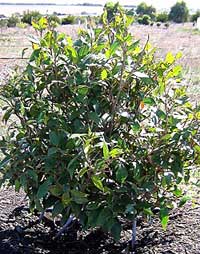
Regional Australia Food - Australian Native Foods: Lemon Myrtle


Photo: Lemon Myrtle

Australia's CSIRO (Commonwealth Scientific and Industrial Research Organisation) is one of the best sources of information (here) on Australia's emerging native foods industry whether you are interested in becoming a producer or as a consumer.

The macadamia nut is Australia's best known native food and so far is the only one to achieve major international success. Lemon Myrtle is probably the next best known.

Growing to a height of over 15 metres, Lemon Myrtle originated in the sub-tropical and tropical rainforest areas of Queensland with a natural rainfall greater than 800m. However, commercial growing was developed in the humid coastal zone of Northen NSW.

The leaves contain between 0.33 - 0.86 % essential oil consisting almost entirely of citral, giving it a strong lemon flavour. In summary:
  • COLOR - bright green herb with pale yellow flecks of citrus
  • AROMA - early sweet lemon, lime and lemongrass oil bouquet with a citrus middle nose
  • PALATE - robust lemon flavour-scent complemented with a mild acid citrus back palate and faint anise and green tea

Current retail product categories include:

  • Tea blends and beverages, dairy, biscuits, breads, confectionery, pasta, syrups, liqueurs, flavoured oils, packaged fish/salmon. Dipping Sauces, Simmer Sauces. For use in sweet and savoury dishes.
  • Non-food products include deodorants, cosmetics, air fresheners, washing powders, disinfectants, soaps and facial creams.

Monday, November 06, 2006

Regional Australia Food - Bush Tucker and Australian Native Foods


Photo: Celebrity chef Mark Olive was recently honoured at the 12th annual Deadly Awards, honouring excellence in Aboriginal and Torres Strait Islander music, sport, entertainment, the arts and community achievement.

Mark hosts The Outback Cafe TV show on Foxtel’s Lifestyle channel, specialising in indigenous Australian cuisine such as possum, emu and native plants.

In a thoughtful response to my last post on bush tucker Vic Cherikoff made the point that there is a huge distinction between bush tucker and authentic Australian ingredients in today's culinary world.

Vic noted that bush tucker covers the food resources of the 600 Aboriginal nations pre-invasion by the English and would include around 2000 different food items from the plant kingdom and perhaps 200 animal and insect foods.

Much of this food is only accessible on location and under the guidance of someone who knows the food stuffs and the area. There is a nice page on Warren Whitfield's The Great Greenway Eco Tours site that will give you a feel here. In Warren's words:

Some of the plant resources utilised by Aboriginal people follow (Please note that some plants contain toxins and irritants. Some plants require treatment prior to eating and not all are edible! DO NOT TRY ANY OF THESE WITHOUT PROPER SUPERVISION).

Vic contrasts bush tucker with Australian native foods, the term used to cover those bush food elements that have been commercialised since the 1980s when Vic and others began work on commercialising bushfoods, thus making them accessible to a wider audience. Since then a considered selection of indigenous foods have entered the market place.

I had not visited Vic's web site before he commented. It includes some fascinating material.

One of the challenges faced by Vic and other pioneers including Mark Olive lies in finding ways to fit ingredients that are both very ancient and new into cuisines that have not had access to them before. Many of the pioneers faced a chicken and egg problem in that they needed to demand to support development but could not attract the required demand without development.

As Vic pointed out, fortunately, we now have over two dozen authentic Australian ingredients forming a backbone of food resources for creative chefs to innovate and develop our own cuisine.