Information about work, life and play in Regional Australia

Showing posts with label Australian native foods. Show all posts

Monday, April 13, 2009

What food did the Aborigines eat in New England?

Keith asked in a comment on Australian Regional Food - Bush Tucker and the Australian Aborigines:

I would love to learn more about bush foods in the New England area, especially around here in Armidale. Most of the wild food information covers Queensland and the Territory, where there appears to be far more bush foods available.

I really don't know. More precisely, I know some of the birds and animals they ate, but not the vegetable material. Something else that I must find out!

Sunday, October 21, 2007

Bunya Mountains National Park


Photo: From Gordon Smith, Grass Tree Forest, Look and See.

Looking slightly surreal, grass trees in State Forest on the edge of the Bunya Mountains National Park, Queensland.

The nuts of the Bunya pine were a traditional food for the Australian Aborigines. When the pine fruited, Aborigines would gather from what is now southern Queensland and Northern New England for ceremonies and to feast.

Today the Bunya Mountains National Park preserves some of this tradition.

Wednesday, December 06, 2006

Regional Australia Food - Stocktake of Posts


Photo: Australian chefs Vic Cherikoff and Benjamin Christie, pioneers in the use of Australian native foods in cooking.

I wish I had more time and more money. I say this because I really would like to be able to investigate all the new foods and wines now appearing in Regional Australia. In the meantime, I thought that I should do a stocktake of current food posts.

Posts on Australian native foods are:

General posts on Regional Australia food are:


Tuesday, November 07, 2006

Regional Australia Food - Australian Native Foods: Lemon Myrtle


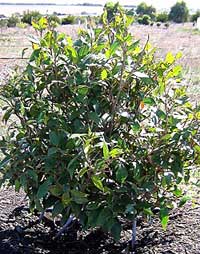
Photo: Lemon Myrtle

Australia's CSIRO (Commonwealth Scientific and Industrial Research Organisation) is one of the best sources of information (here) on Australia's emerging native foods industry whether you are interested in becoming a producer or as a consumer.

The macadamia nut is Australia's best known native food and so far is the only one to achieve major international success. Lemon Myrtle is probably the next best known.

Growing to a height of over 15 metres, Lemon Myrtle originated in the sub-tropical and tropical rainforest areas of Queensland with a natural rainfall greater than 800m. However, commercial growing was developed in the humid coastal zone of Northen NSW.

The leaves contain between 0.33 - 0.86 % essential oil consisting almost entirely of citral, giving it a strong lemon flavour. In summary:
  • COLOR - bright green herb with pale yellow flecks of citrus
  • AROMA - early sweet lemon, lime and lemongrass oil bouquet with a citrus middle nose
  • PALATE - robust lemon flavour-scent complemented with a mild acid citrus back palate and faint anise and green tea

Current retail product categories include:

  • Tea blends and beverages, dairy, biscuits, breads, confectionery, pasta, syrups, liqueurs, flavoured oils, packaged fish/salmon. Dipping Sauces, Simmer Sauces. For use in sweet and savoury dishes.
  • Non-food products include deodorants, cosmetics, air fresheners, washing powders, disinfectants, soaps and facial creams.

Monday, November 06, 2006

Regional Australia Food - Bush Tucker and Australian Native Foods


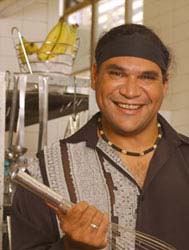
Photo: Celebrity chef Mark Olive was recently honoured at the 12th annual Deadly Awards, honouring excellence in Aboriginal and Torres Strait Islander music, sport, entertainment, the arts and community achievement.

Mark hosts The Outback Cafe TV show on Foxtel’s Lifestyle channel, specialising in indigenous Australian cuisine such as possum, emu and native plants.

In a thoughtful response to my last post on bush tucker Vic Cherikoff made the point that there is a huge distinction between bush tucker and authentic Australian ingredients in today's culinary world.

Vic noted that bush tucker covers the food resources of the 600 Aboriginal nations pre-invasion by the English and would include around 2000 different food items from the plant kingdom and perhaps 200 animal and insect foods.

Much of this food is only accessible on location and under the guidance of someone who knows the food stuffs and the area. There is a nice page on Warren Whitfield's The Great Greenway Eco Tours site that will give you a feel here. In Warren's words:

Some of the plant resources utilised by Aboriginal people follow (Please note that some plants contain toxins and irritants. Some plants require treatment prior to eating and not all are edible! DO NOT TRY ANY OF THESE WITHOUT PROPER SUPERVISION).

Vic contrasts bush tucker with Australian native foods, the term used to cover those bush food elements that have been commercialised since the 1980s when Vic and others began work on commercialising bushfoods, thus making them accessible to a wider audience. Since then a considered selection of indigenous foods have entered the market place.

I had not visited Vic's web site before he commented. It includes some fascinating material.

One of the challenges faced by Vic and other pioneers including Mark Olive lies in finding ways to fit ingredients that are both very ancient and new into cuisines that have not had access to them before. Many of the pioneers faced a chicken and egg problem in that they needed to demand to support development but could not attract the required demand without development.

As Vic pointed out, fortunately, we now have over two dozen authentic Australian ingredients forming a backbone of food resources for creative chefs to innovate and develop our own cuisine.

Saturday, November 04, 2006

Australian Regional Food - Bush Tucker and the Australian Aborigines.


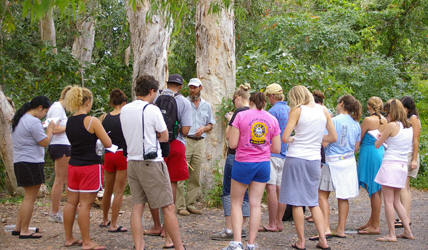
Aboriginal botanist Warren Whitfield teaches students from Atlanta (US) Emory University about Aboriginal fire-stick management practices and how this affected vegetation. The trees in the background are: Melaleuca leucadendra The Weeping Tea Tree, Paper Bark Tree. Why do these trees have hard flammable leaves and what did Aboriginal people use this plant for?

In recent years there has been growing interest in Australia in traditional Aboriginal life, in the way they managed the country, in the life they led and the foods they ate. When the Europeans first arrived, they too, supplemented the European style diet with local foods. As the country became more urbanised this interest died, in part because of greater availability of other foods, in part because Australian food and animals had not been (apparently) cultivated, domesticated and were less readily available to a growing population.

I say apparently because the Aborigines had developed quite sophisticated ways of managing the country. Here I was fascinated to discover when reviewing the anthropological literature for my history honours work all those years ago (I was part of what was I think Australia's first Australian pre-history class in 1966 at the University of New England) that the Aborigines had actually worked significantly less hours than Europeans had too.

So I plan to look at bush tucker as part of my Regional Australia food series. As a first step for those who are interested, you might like to start here, a Queensland school site on bush tucker.