Information about work, life and play in Regional Australia

Tuesday, November 07, 2006

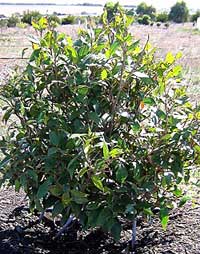
Regional Australia Food - Australian Native Foods: Lemon Myrtle


Photo: Lemon Myrtle

Australia's CSIRO (Commonwealth Scientific and Industrial Research Organisation) is one of the best sources of information (here) on Australia's emerging native foods industry whether you are interested in becoming a producer or as a consumer.

The macadamia nut is Australia's best known native food and so far is the only one to achieve major international success. Lemon Myrtle is probably the next best known.

Growing to a height of over 15 metres, Lemon Myrtle originated in the sub-tropical and tropical rainforest areas of Queensland with a natural rainfall greater than 800m. However, commercial growing was developed in the humid coastal zone of Northen NSW.

The leaves contain between 0.33 - 0.86 % essential oil consisting almost entirely of citral, giving it a strong lemon flavour. In summary:
  • COLOR - bright green herb with pale yellow flecks of citrus
  • AROMA - early sweet lemon, lime and lemongrass oil bouquet with a citrus middle nose
  • PALATE - robust lemon flavour-scent complemented with a mild acid citrus back palate and faint anise and green tea

Current retail product categories include:

  • Tea blends and beverages, dairy, biscuits, breads, confectionery, pasta, syrups, liqueurs, flavoured oils, packaged fish/salmon. Dipping Sauces, Simmer Sauces. For use in sweet and savoury dishes.
  • Non-food products include deodorants, cosmetics, air fresheners, washing powders, disinfectants, soaps and facial creams.

Monday, November 06, 2006

Regional Australia Food - Bush Tucker and Australian Native Foods


Photo: Celebrity chef Mark Olive was recently honoured at the 12th annual Deadly Awards, honouring excellence in Aboriginal and Torres Strait Islander music, sport, entertainment, the arts and community achievement.

Mark hosts The Outback Cafe TV show on Foxtel’s Lifestyle channel, specialising in indigenous Australian cuisine such as possum, emu and native plants.

In a thoughtful response to my last post on bush tucker Vic Cherikoff made the point that there is a huge distinction between bush tucker and authentic Australian ingredients in today's culinary world.

Vic noted that bush tucker covers the food resources of the 600 Aboriginal nations pre-invasion by the English and would include around 2000 different food items from the plant kingdom and perhaps 200 animal and insect foods.

Much of this food is only accessible on location and under the guidance of someone who knows the food stuffs and the area. There is a nice page on Warren Whitfield's The Great Greenway Eco Tours site that will give you a feel here. In Warren's words:

Some of the plant resources utilised by Aboriginal people follow (Please note that some plants contain toxins and irritants. Some plants require treatment prior to eating and not all are edible! DO NOT TRY ANY OF THESE WITHOUT PROPER SUPERVISION).

Vic contrasts bush tucker with Australian native foods, the term used to cover those bush food elements that have been commercialised since the 1980s when Vic and others began work on commercialising bushfoods, thus making them accessible to a wider audience. Since then a considered selection of indigenous foods have entered the market place.

I had not visited Vic's web site before he commented. It includes some fascinating material.

One of the challenges faced by Vic and other pioneers including Mark Olive lies in finding ways to fit ingredients that are both very ancient and new into cuisines that have not had access to them before. Many of the pioneers faced a chicken and egg problem in that they needed to demand to support development but could not attract the required demand without development.

As Vic pointed out, fortunately, we now have over two dozen authentic Australian ingredients forming a backbone of food resources for creative chefs to innovate and develop our own cuisine.

Saturday, November 04, 2006

Australian Regional Food - Bush Tucker and the Australian Aborigines.


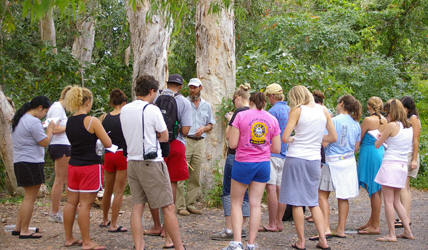
Aboriginal botanist Warren Whitfield teaches students from Atlanta (US) Emory University about Aboriginal fire-stick management practices and how this affected vegetation. The trees in the background are: Melaleuca leucadendra The Weeping Tea Tree, Paper Bark Tree. Why do these trees have hard flammable leaves and what did Aboriginal people use this plant for?

In recent years there has been growing interest in Australia in traditional Aboriginal life, in the way they managed the country, in the life they led and the foods they ate. When the Europeans first arrived, they too, supplemented the European style diet with local foods. As the country became more urbanised this interest died, in part because of greater availability of other foods, in part because Australian food and animals had not been (apparently) cultivated, domesticated and were less readily available to a growing population.

I say apparently because the Aborigines had developed quite sophisticated ways of managing the country. Here I was fascinated to discover when reviewing the anthropological literature for my history honours work all those years ago (I was part of what was I think Australia's first Australian pre-history class in 1966 at the University of New England) that the Aborigines had actually worked significantly less hours than Europeans had too.

So I plan to look at bush tucker as part of my Regional Australia food series. As a first step for those who are interested, you might like to start here, a Queensland school site on bush tucker.

Tuesday, October 31, 2006

Studying in Regional Australia - Central Queensland University


Photo: Montage, Rockhampton Queensland

The various universities located in Regional Australia form a critical part of the regional infrastructure and offer an education that is as good, in many cases better, than that offered by their metro cousins.

The Central Queensland University was founded in 1967 as the Queensland Institute of Technology (Capricornia) and has 24 000 students from over 120 countries.

A leading provider of distance education, CQU has campuses in Rockhampton, Bundaberg, Gladstone, Mackay and Emerald plus delivery sites on the Sunshine Coast . The University operates international campuses in Sydney, Brisbane, Melbourne, Gold Coast and Fiji with offshore delivery sites in Hong Kong , Singapore and Shanghai.

The main campus is located in Rockampton, a major regional city with 60,000 living in the city itself, 100,000 in the greater Rockhampton area. The city is situated on Queensland's largest river, the Fitzroy, 40 kilometres inland from the beautiful Capricorn Coast beaches.

Founded in 1858, Rockhampton grew on the wealth of gold rushes and cattle empires. The City's Quay Street Heritage Precinct has well preserved heritage architecture, including historic Customs House and the classic Walter Reid Cultural Centre. The city claims with justice that very few regions offer the affordable lifestyle advantages of Rockhampton's tropical climate and all year outdoor lifestyle

Like many other of Regional Australia's universities, CQU ranks high on student satisfaction.

According to The Good Universities Guide 2006 , no other Queensland university rates higher than CQU for positive graduate outcomes. The Guide gives CQU a top rating (5 stars) for graduate outcomes and above average (4-star) ratings for graduate starting salaries and job success. CQU graduates have one of the highest employment rates in the country. According to the Graduate Careers Council of Australia (2005), almost 91 per cent of CQU graduates with a bachelor degree found full-time work within four months of finishing university as compared to a national average of 81 per cent.

More than 100 undergraduate and postgraduate programs are offered by the University's three Faculties:
  • Arts, Humanities and Education
  • Business and Informatics
  • Sciences, Engineering and Health

The University hosts the Institute for Sustainable Regional Development and is also a partner in four Co-operative Research Centres (CRCs):

  • CRC for Coastal Zone, Estuary and Waterway Management
  • CRC for Cast Metals Manufacturing
  • CRC for Railway Engineering and Technologies
  • CRC for Integrated Engineering Asset Management

Friday, October 27, 2006

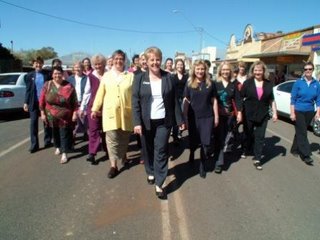
Guyra, New England - the birds of Bradley Street


Photo: the birds of Bradley Street

Located on the Northern Tablelands of NSW at an altitude of 1,320 metres, Guyra (population 2,200) is one of the highest if not the highest town in Australia.

Like a number of our inland towns, Guyra went through difficult times because of rural downturn combined with closure of the local abbatoir. Shops closed, house prices collapsed, people left.

Guyra fought back and has been going through an economic resurgence due in part to a remarkable group of women - the birds of Bradley Street (Guyra's main street) - including a number of tree changers.

Two and a half years ago, Leanne Emmerton bought the Guyra Emporium, a long-established business housed in what was previously the Arcadia Theatre.

The Emporium sells furniture, camping gear, hardware, giftware, homewares and toys. Since taking it over, Leanne has renovated and introduced news lines of stock and given the place what she calls a woman's touch.

"It was previously owned by the same family for 25 years, basically run by a father and son, and I really don't think the store had seen a duster in years", Leanne recalled.

She is certainly getting positive feedback from the out-of-towners. One Sydney resident who shopped there told her that he would have had to shop in 10 different places to get everything he bought there that day!

Melbournite Julie Mills shifted to Guyra with her husband and young son in 2004 on a 12-month trial basis and bought an old department store to set up Black Sheep Wool'n'Wares. The business is now thriving and Julie hasn't looked back.

The store stocks wools, knitting patterns, woollen clothing and soft toys, and is a key element of Guyra's unique village shopping precinct.

In 2004, Grace Kane, a Guyra local for the past 15 years, established gGs, a family department store and boutique, with the aim of creating a destination rather than just a retail store.

"I was running the newspaper and I actually felt the town was quite sad," Grace recalled. "It was a dream of mine to buy the store and make the town come alive."

gGs is a historic attraction in itself, as one section of the store is located in the original Guyra Refreshment and Tea Rooms, built in 1900. Much of the store contains renovated or recycled items from its past life as a family run general store.

Nicole O'Malley Jones opened her Fork and Spoon Cafe and Pantry in November 2005 after she and her husband Stephen Earl decided that Guyra had great potential for growth.

The couple, who relocated to Armidale five years ago, have 20 years experience in the hospitality industry in Brisbane, Sydney and London.

"We found the prices appealing in Guyra, saw that employment was good and believed there was a market for the gourmet products we stock here, as well as the cafe", Nicole said.

Nicole has introduced some new features to her business, like a tealeaf reader twice a week, and traditional high teas. It is quite likely she will open the cafe for special dinner functions in conjunction with the recently established Guyra Theatre Group.

A longer-term tenant of Bradley Street is the Guyra Adult Learning Association (GALA) which has been operating for 23 years.

GALA offers a range of courses to adults, both vocational and leisure-oriented, and recently expanded its services into Armidale.

Other female-owned businesses in Bradley Street include: JoJos on Bradley, a cafe owned by Jo Burey; the Body and Soul Sanctum, opened in May 2006 by Benita Filipovich; Jenni Jackson's Jenni Jackson Guyra Pharmacy; and a naturopath clinic run by Rene Lockrey.

In Jenni Jackson's view women are the primary consumers so it's been good to see so many businesses in Guyra run by women.

"I think women have that retail focus as well as compassion and understanding for their customers, which works really well, particularly in a country town."

Guyra's development has been further aided by the Costa Group's $36 million hydroponic tomato growing operation attracted to the town by the availabilty of land, clean air and water. This began just over 12 months ago, is now in its second stage of construction and when complete is expected to employ up to 200 people.

Guyra Shire Mayor, Robyn Jackson, said the fact that women have really taken the bit between the teeth and made things happen both personifies the area and demonstrates their self-belief.

"There were so many empty shops a while ago and I think their presence actually inspired these women to see their potential", Cr Jackson said.

"Now you don't have to leave town to find luxury items, and shopping has become more of an experience in itself. I have had visitors from out of town giving me positive feedback about browsing through the shops, then enjoying a coffee afterwards."

Location Details

Guyra is on the New England Highway and is well located in terms of access to other centres.

Armidale with its major educational facilities including the University of New England is only 30 minutes away by car. Other nearby centres include Inverell (one hour ten minutes ) and Glen Innes (45 minutes). There are a number of nearby national parks including the New England National Park (one hour 20 minutes) and Dorrigo (one hour 30 minutes).

The nearest beach is two hours 15 minutes away via Dorrigo and the beautiful Bellinger Valley. Brisbane (five and a half hours) and Sydney (seven hours) are further by road, although the nearest major airport is only 30 minutes away at Armidale with plenty of free parking.

Further information on Guyra businesses can be obtained from Robyn Ryan, Guyra Shire Council's Economic Development Manager, (02) 6779 1577 or visit the Guyra Shire Council web site.
Thursday, October 26, 2006

Regional Australia - Worthwhile Web Sites


Photo: Gordon Smith, Armidale NSW

Another of my periodic posts on worthwhile web sites found in my travels.

The Australia Blog bills itself as the one stop travel guide to Australia and indeed it does provide access to some interesting material.

yourseachange.com is an interesting on-line magazine providing information for all those interested in tree or sea change. Update 5 August 2010. Sadly this site has turned into an un-related ad platform.

I have mentioned Gordon Smith's Look and See photo blog before because of its wonderful photos of Regional Australia.

Phillip Diprose's Ochre Achives, another blog that I have mentioned before, provides an interesting picture - life, wildlife, soils etc - of one property in regional NSW.

Michael Kiely's Diary of a Carbon Farmer bills itself as : This is the diary of an Australian family who escaped from the city, joined a farming community, and learned to love soil. Carbon Farming is about growing soil carbon - the first link in our food chain. The topsoil is where God's creation is taking place, at every moment. Carbon is the building block of life. By growing it we can restore ecosystems to health. At the same time we can remove Carbon Dioxide from the atmosphere and store it as Carbon in the soil.

Regional Australia Real Estate - Heaven Sales

I was fascinated to come across the term "Heaven Sales" applied to regional real estate. I knew the phenomenon but had not heard the term.

Regional people are not dumb. Because of the still large gap between metro and regional real estate prices, some people are putting houses (often on acreage) on sale on-line at inflated prices in local terms hoping to attract city buyers who simply do not know better. If they sell, they are in heaven, hence the term. And some are selling.

The problem with this approach is that it distorts the local marketplace while leaving the city buyer with an over-valued asset. So while real estate in Regional Australia still offers very real bargains, please check the local market place before buying that apparently attractive property.

Tuesday, October 24, 2006

Australian Regional Food - Looking Back 3: Catering for Large Numbers


In my first post on this topic I indicated that one of the reference sources that I was using was the CWA Cookery Book and Household Hints.

I covered the history of the Country Women's Association of NSW in an earlier post on the New England, Australia blog. In short, the CWA was established in all Australian states to provide mutual support for often isolated country women.

One feature of country cooking was the way in which country women had to cook for very large numbers often using very limited ingredients. This might happen during shearing, working bees or at social gatherings. In the case of the CWA itself, the organisation generated funds by catering at stock sales and country shows.

These needs come through in the first part of the Cookery Book. So the first item is catering for 50 people followed by afternoon tea at a Fete. In the case of the Fete, the Book advises allowing 2 sandwiches, 2 pieces of cake and half a scone per person. Instructions are then provided on the quantities required.

After dealing with a wedding breakfast for 100 guests, the Book provides catering details for serving approximately 300 adults at a public stock sale with a lunch consisting of cold meat and salad with sweet to follow. Then there are descriptions of a potato salad for 100, pea soup for 120.

Reflecting limited money and ingredients, the food can best be described as plain. Thus for sweets to serve 300 adults at a public stock sale you need:
  • a large baked custard
  • 2 large triffles
  • 2 cases of apples
  • 6 tins of fruit
  • 2 and half kilos (5lbs) of pastry.

The book notes that sweets may be varied according to availability of material (ie cream, fruit etc).

Thursday, October 19, 2006

Regional Living Australia - Questions & Answers

We have been doing some tidying up on the main Regional Living Australia site. We have had a question and answer section on this site. However, this role is meant to be fulfilled by this blog. So to tidy up, we have transferred the material in the following questions/answers to this blog.

I and my colleagues remain very happy to answer questions that you might have about Regional Australia. We are now thinking through just how this might be done in the best way.

Practising Law in Regional Australia

Question

What career opportunities are open to me in Regional Australia? Question raised at Country Week 2005 by a young lawyer just completing his practice certificate.

Answer

The short answer is a lot.

Unlike some metro areas where legal professionals are in relative over-supply, many regional areas throughout Australia have immediate job vacancies. Further it is much easier to establish your own practice or to acquire a partnership in an existing practice. Adjusted for practice and living costs, profit per partner can be significantly higher than the city suburban average.

However, the starting point in considering these has to be your own needs, aspirations and areas of interest.

Regional Australia involves a hierarchy of communities from small centres through to major regional cities.

Practice in the smaller communities is very different from that generally found in the metro areas.

Lawyers have to be more generalist working across fields including criminal law, family law, conveyancing and local government matters. The relationship with clients is also different in that the lawyer is more likely to be the key source of advice instead of simply one among a range of advisers.

Bigger communities such as major regional cities offer more scope for specialisation in practice simply because the business base is larger. In addition, while regional businesses do use metro solicitors to meet particular needs, their preference for local support creates opportunities in areas such as commercial, corporation and property law. Simply put, competition for supply of services in these areas is less than in the bigger metro centres.

There is also great variation within regional Australia in demographic structures and the type and level of economic activity. This creates significant variations in practice possibilities that need to be individually investigated. Examples include agribusiness and rural law in major farming districts, estate planning in retirement areas, business succession planning, biotechnology in certain areas, different types of employment related law depending upon the dominant industrial base.

Partnership opportunities can be very good. Because many law graduates prefer to work in metro areas, the average age of regional solicitors tends to be higher. Practice succession is an important issue, creating a range of partnership possibilities.

All lawyers need to maintain professional currency. It used to be the case that the tyranny of distance made it more difficult to keep in professional touch. However, the existence of on-line resources as well as professional support mechanisms now places all lawyers on a more even footing regardless of location.