Information about work, life and play in Regional Australia

Showing posts sorted by relevance for query olives. Sort by date Show all posts

Thursday, January 04, 2007

Olives in Regional Australia - Information Sources


Just completing my immediate posts on Australian olives.

In my first post on olives in Regional Australia I mentioned that when I was growing up I thought of olive oil as a medicinal product. Now I use olive oil all the time in cooking, while olives are a constant element in my diet.

I still use overseas olive products and will continue to do so, but now I have embarked on the joy of discovering the Australian alternative.

The Australian Olive Association site is perhaps the best entry point for those interested in finding out more about Australian olives whether as a consumer or potential grower. The site includes details of local producers for both olive oil and table olives.

For those interested in growing olives, the Olive business site provides a handy introduction. The Rural Industries Research and Development Corporation site provides information on the development of the Australian olive industry.

At regional level:

As part of my web searches I also checked blogs. I could only find one. Olives101.com is a global olives blog that includes regular stories on Australian and New Zealand olive growing.

Sunday, February 04, 2007

Regional Australia - Olives Update

Photo: Hand Harvesting Olives

Someone asked me why I featured olives on this blog.

It's partly because I like olives, partly because olives and olive growing is a sign of the diversification sweeping Regional Australia as the old monoculture is replaced by a greater variety of local food products. This is progressively transforming regional life, deepening variety and texture. I find this exciting.

I have to thank olives101, still my favourite olives site, for two stories.

In the first, they drew my attention to a new book Producing Table Olives in Australia designed to help those interested in entering the industry. Here I also noticed that the NSW Department of Primary Industry has a useful paper on the Australian olive industry.

Did you know, I didn't, that since the mid 1990s around 30,000 hectares have been planted to olives in Australia? That's actually a lot of olives! At some point I must talk about the problem of feral olives, something that raises the vision of wild olive trees prowling the by-ways of Regional Australia!

In the second story, olives101 drew my attention to a new development by scientists at Charles Sturt University, a university I spoke of in a recent post.

Scientists at Charles Sturt University and the Heart Research Institute have discovered that the dregs of olive oil have anti-inflammatory benefits.

The pulp contains over 100 antioxidants, several of which they believe could be beneficial in halting hardening in the arteries, or atherosclerosis, associated with poor heart health.

At present, only two per cent of the antioxidants in the fruit actually end up in the oil, with 98 per cent remaining in the pulp. The discovery holds out the possibility of using the pulp.

"It's very exciting to discover something that is just raw waste disposal at the moment has properties that could be used to heal," said chemistry scientist Dr Paul Prenzler.

Saturday, December 23, 2006

Olives in Regional Australia - Introduction


Photo: Green Frantoio. Australian Olive Association

When I was growing up in Regional Australia olives were still an alien product. Yes, we ate them sometimes, but we never used olive oil. In fact, as a child I confused olive oil with cod liver oil, a nasty tasting substance that our mother used to give us sometimes when we were off- colour.

How things change. Now I use olive oil all the time in cooking, while we eat olives two to three times per week in anti pasto. I do not pretend to be expert, but certainly my own views have changed enormously.

This change in my own habits is a sign of a broader change.

I did not know until I came to research this story that olive growing had a long history in Australia.

The history of olive farming in Australia dates back to the early 1800’s. Olives were probably first planted in groves around 1805 in Parramatta near Sydney.

All the states and territories, excluding Tasmania were planted with some varieties of olive trees during the 1800s. During this period, South Australia and Victoria were the states where most of the planting was going on and they were considered the leaders at that time.

The problem with these early plantings was that Australians at the time (like me) saw olive oil as a medicinal rather than culinary product, thus limiting demand. Like wine, olives were very much a minority product.

It was not until the fifties when large numbers of settlers came to Australia from Southern Europe that community attitudes began to change. These settlers brought their diet with them.

Initially this had limited impact. Then, as with so many other areas of Australian life, their tastes began to spread into the broader community. As they did, demand for olives and olive oil as a food product began to increase.

In the beginning, this demand was met largely from European imports. However, recent decades have seen a rapid expansion of Australian plantings, leading to the development of a local olive industry. As with wine, Australia is fortunate to have large areas of country suitable for olive growing, facilitating expansion.

I suspect that the local olive industry now stands in roughly the same place that wine did in the sixties. Then no one could have envisaged the huge growth in the local industry nor the fact that Australian wine would become such a force in the global wine marketplace.

Like wine, the Australian olive industry has to educate consumers about the local product. Again like wine, the local olive industry has a strong boutique element as producers in various parts of the country attempt to establish individual reputations.

Unlike wine, though, which in some ways had to start from scratch, the olive industry is building from an already established and growing culinary base. It is no coincidence that there is a strong relationship between wine and olive growing regions.

Major Australian olive regions include:

  • Moore River Region, Margaret River and Great Southern Regions of Western Australia
  • Fleurieu Peninsula and the East/South East of South Australia
  • North, Central and Western Victoria
  • Northern Slopes of New South Wales, Hunter Valley and the Murray Irrigation Area
  • South Eastern Queensland

Friday, June 01, 2007

Regional Australia food, olives and agriturismo

There have been a couple of recent posts on other blogs that brought together in my mind several themes that I have been writing about.

Over the last twelve months I have watched with pleasure the spread of bottles of Australian produced olive oil on Australian supermarket shelves.

As a story on the history of olive oil on olives101 reminds us, olives and olive oil have a long history. Yet in Australia the major use of olive oil is very recent. Growing up, olive oil was largely a medicinal product. Now it is something that I use all the time, a fundamental staple.

Olive oil production in Australia has a long history. But again until very recently, its production was very much a minor niche activity. Now olives and olive oil are produced in many parts of the country. Yet there is still a problem in all this.

On his rather wonderful View Italy blog, David Anderson writes a lot on the Italian regional experience, drawing out both the texture and variety of regional experience across the country. He also writes on agriturismo, essentially the way in which rural life is integrated into the regional experience.

The position in Australia is very different. In several posts on another blog we commented on some of the failings of Australian tourism at regional and local level.

A core failing is the failure to properly identify and build on the unique features of each location or region. For some reason, all areas try to promote general attributes that they feel will appeal.

Take farm stays. This is a very different concept to agriturismo as I understand the term. With farm stays you end up with a generic list all promoting experiencing farm life in some way. There is little focus on the unique life and experiences of the area.

Or take the currently very fashionable Opera in the Vineyards, something that has proliferated across Australia's wine growing areas. This is something designed especially to appeal to metro audiences, and there is nothing wrong with that per se. But it is another generic activity copied from area to area with few distinguishing features.

This problem is not unique to Regional Australia. When Steve Irwin was appointed to act as Australia's tourism ambassador, Sydney radio presenter Richard Glover complained that he would much rather have Australia remembered for its cultural activities such as its symphony orchestras. But, as callers quickly pointed out, who is going to visit Australia to go to a concert?

The difficulty in all this is that we get a sort of metro blandness and uniformity imposed across the whole country, one that catches everyone in the same mental trap.

How does all this link to olives and to regional food more broadly?

I recently visited a major vineyard, the site of one of the Opera's in the Park. On one wall they had a small display of Australian foodstuffs including bottles of olive oil. But there was no explanatory material, they were not integrated in any way with the rest of the cellar door, many were not even local. They were just another example of a generic trend.

The same thing applied to local food. It was all just that bland uniformity called Australian modern, and this in an area noted for certain types of local foodstuffs.

If all this is to change, it has to start at local and regional level with a focus on the special features of that area. Many of those features may be the same as other areas, but the combination is always different. So let's celebrate our diversity.

Saturday, April 28, 2007

Regional Australia Food - stocktake of posts as at 28 April 07

This post provides an update of various posts on food in Regional Australia, replacing the previous post of 6 December 2006.

Posts on Australian native foods are:

General posts on Regional Australia food are:

Thursday, July 17, 2008

Visiting Canberra - driving around, lunch, dinner, Sunday at the National Gallery


Photo: National Gallery, Picture Parade, Asia-Pacific Photos 1840s-1940s.

Loaded with our Murrambateman Ravensworth sangioves, bread, imported cheese plus Ligurian olives, we left Manuka for a drive round the areas of Canberra that we had both known.

As reported in Canberra's changing life style - past and present, I was struck with what I saw as the deterioration in some of the older suburbs. I know that water restrictions have had an impact, but it was more than that. But many of the suburbs we knew so well have become drab and untidy. Still, we did enjoy our drive.

About 3 pm we returned to our hotel room for a picnic - the Ravensworth sangiovese, fresh bread, Barossa fine foods salami, Ligurian olives, Roy de Valles semi hard cheese at $88.11 per kilo, Gorgonzola Piccante at $57.50 per kilo. This was a very expensive picnic, but it was fun.

A sleep, and we were ready to go out for dinner in Kingston. We had wanted to go to La Rustica but this was full. Instead, we got into Figaro on a cancellation.

This proved a good choice. Our waiter was friendly and helpful, able to comment on both food and wine. So we settled down with a bottle of Danzanti Pinot Grigio 2006 from the Venezia region while we made our choices. We chose this wine because youngest was in fact in Venice, but it was rather nice.

I do not have all the notes on our food, I will have to remedy this if I am going to do more posts like this one, but I would put the food at 8 out of 10, the service 10 out of 10.

Home to watch the Tour de France.

Morning and breakfast in the hotel. This was pretty ordinary. Too few Australian hotels can do a decent breakfast, although I admit I have high standards here. Then to the National Gallery.

I love Australia's National Gallery. It's not as big, monumental, as some of the European Galleries. Living in Canberra I was a member and often went there over lunchtime just to wander around.

Now the trees have grown changing the external feel, but internally it's still remarkably compact. We worked our way round, although I would really have liked multiple visits.

After coffee we got on the road, and so to Sydney. It had been a fun trip.

Back to the introductory post in the series.

Monday, July 11, 2011

Moree - live the lifestyle

I have often remarked about the variety of regional life styles. As this YouTube video says, Moree may not be Paris, but it has its own unique style!

For those who don't know Moree, it is situated in northwest New England 640 kilometers from Sydney and 480 kilometers from Brisbane. Moree has an enthusiastic supportive friendly caring community with a great lifestyle and many great sporting opportunities.

The black alluvial soils of the Gwydir Valley are some of the richest in the southern hemisphere. Moree Plains Shire is the most productive agricultural shire in Australia. Major agricultural industries are cotton, beef cattle, pecan-nuts, olives, wheat, sheep wool, cereal crops.

Moree is famous for its Hot Mineral Baths which originated in 1895. The baths were discovered accidentally when searching for irrigation water. These mercurial waters are from bores sunk into our amazing great Artesian Basin. 300,000 visitors of all ages visit annually. Many believe in the healing powers of the Artesian mineral waters. There are two large hot pools with temperatures ranging from 39 to 41 degrees, A 50 meter 6 lane Olympic Pool, a Junior Pool and a Toddlers pool.

Enjoy.

Tuesday, July 15, 2008

Visiting Canberra - wandering round Manuka

Breakfast over, Dee and I went for a wander round Manuka just to see what had changed.

I am not a shopping person. I am not a shopping person. My wife and daughters are. Give them a shop and they will enter, even if they cannot afford to buy anything! Still, in this case I went along because I wanted to look at the shops myself.

One advantage that Manuka has over Sydney shopping centres is that the shops are in a self-contained space. This makes it very easy to browse.

We started at the Sheridan shop. I really liked this one because it had so many towels and sheets in one place. I was not in a buying mood, but I do like bright colours. From here we went to the various clothes' shops.

To me, Carla Zampatti is Carla Zampatti, just a name. Still, I was struck here and in other shops with the winter range. Like Melbourne, Canberra's winter climate means that there are clothes that you will not find in Sydney. This I liked.

Still, as a mere male the prices amazed me. Those who have known Manuka from the past will know that Millers of Manuka has been there for a very long while.

Millers used to be a middle of the range store. Not any more. It was sale time, so I looked at some of the labels. There was, for example, a nice Kenzo jacket. This had been discounted so that it was an absolute steal at a price of a just $1,630! I could see why so many of the people in Manuka seemed to be well and expensively dressed.

In all this, my favourite store was the Wine & Cheese Providores.

The wine can be found in the lower level store. I simply cannot afford some of the wines there, but it was nice looking. I was especially interested in the local wines, and here upon recommendation we bought a bottle of Murrambateman Ravensworth sangiovese for $22. I had not tried this grape before, but the wine was highly recommended.

Then we went outside and up the stairs to the cheese section. This is also a cafe. There we bought some bread, imported cheese plus Ligurian olives to go with our our sangiovese for lunch.

Entry post in this series here.

Thursday, November 23, 2006

What has Jane Austin got to do with food in Regional Australia?


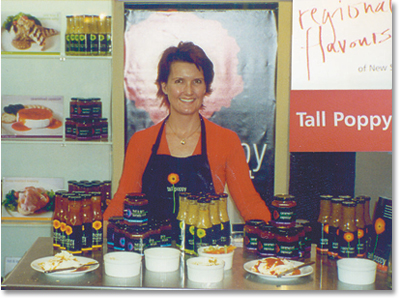
Photo: Virginia Enzerink, Tall Poppy Gourmet, Cowra NSW


What, indeed, does Jane Austin have to do with food in Regional Australia?

I have just been watching Pride and Prejudice (again!) with my daughters. I do wish that I had ten thousand pounds per annum in funds so that I could properly focus on food in Regional Australia.

Today I received an email from Nicki providing information on Nosh on the Namoi. I always try to check my facts first before writing, so I dug down.

A few facts before my mouth starts watering too much.

On Saturday 31 March next year New England town of Narrabri will celebrate the 5th birthday of its annual food and wine festival, Nosh on the Namoi. I will describe the day in a moment. A little history first.

Nosh on the Namoi began with 27 exhibitors presenting products such as olives, ice cream, wine, crayfish, smoked trout, beef, herbal tea, locally produced pasta, preserves, chicken, oysters, condiments, caterers and restaurants.

Digging down further I found that Bellata Gold had been launched at Nosh on the Namoi.

Now I already knew about Bellata Gold from Regional Food Australia. The family owned firm produces the finest quality chemical free pasta, semolina and Durum flour products using traditional methods of low temperature drying, ensuring that their unique flavour is retained in pasta and distinctive herb blends. Then I found that Tall Poppy Gourmet with its luscious relishes had been launched there as well.

I will do a fuller story later. In the meantime, I just wish that I too had ten thousand per annum to help me travel Regional Australia just tasting the food and wine.

Sunday, June 03, 2007

Regional Australia food - creating regional differences


Photo: Cape Willoughby Lighthouse, Kangaroo Island, South Australia.

Interesting off-line discussion triggered by my last post on Regional Australia food, olives and agriturismo.

There were two main lines of attack.

Number one: to what degree can we talk in any meaningful way about variations in food across Australia? Number two: in suggesting that areas should aim to build their unique features in wine, food and cooking, am I guilty of trying to create artificial differences?

On the first, I think that there are already differences in food and cooking across Australia, although these are largely driven by differences in climate and availability rather than than differing regional histories and cultures. You only have to compare menus in, say, Port Douglas and Hobart to see what I mean.

On the second, perhaps I am.

I am certainly not suggesting that Australian regions should aim to create the type of regional variations that exist in Italy because these are deeply rooted in long regional histories and in varying home life. But I do think that that there is scope to focus and build on the special features belonging to each Australian region to the benefit of both locals and visitors.

We can see this to in South Australia's Kangaroo Island, for example, where they are consciously promoting local food and wine as part of the overall Island package. In their words:

The lack of large-scale development has meant that small industry has flourished and now includes a variety of products such as free-range chicken and eggs, olive oil, native jams, smoked fish, sauces and marinades.

Kangaroo Island's apiarists harvest honey from the pure strain Ligurian bees, and regional cheeses and yoghurts continue to find a place in food lovers' hearts.

Fresh seafood is featured across the Island and seasonally you can enjoy a variety of natural and farmed produce such as oysters, prawns, crayfish, whiting, snapper and, not forgetting freshwater marron - it's so easy to get a taste for Kangaroo Island!

Now all this is mouth watering. But I would like it to go a stage further, moving from differences in local produce to dishes based on that produce. Now these dishes do not need to be unique, simply specialities based upon local produce that can be presented as part of the visitor experience. In time, this will naturally produce a local cuisine if such does not already exist.

Tuesday, April 22, 2008

The lost art of the Australian picnic


Photo from taste.com.au

Growing up, picnics were still a central feature of Australian life. There were organised events such as sunday school picnics, school picnics or picnic races. But far more common was the simple domestic picnic.

These were in part excursion, getting out to a nearby picnic spot. But they were also a central feature of travel, with families stopping by the side of the road to have a cup of tea or coffee and something to eat.

Then, almost overnight, they seemed to vanish, replaced by fast food or BBQs. Don't get me wrong, I like a good BBQ, but the picnic has the advantage that you can eat in many more places.

Picnics still exist, but they have become much more ornate occasions. Again don't get me wrong. I do not object to a range of specially prepared food. However, there is a lot to be said for simplicity.

I think that the key thing about a picnic is that it can take so many forms.

When travelling on a tight budget in Europe, we used to picnic in our hotel room at lunchtime, combining bread, cheese and things such as olives and salami, washed down with a rough red.

Travelling in Australia, I fear that we have fallen into the habit of stopping at those monster road side stops that now dot the express ways. This is a real error. It quite destroys the pleasure that can be obtained from a more relaxed stop in a pleasant place.

Yes, the monster road stops are useful when travelling quickly from point A to point B, although even then there is something to be said for stopping by the road to picnic. But there is really no excuse when touring.

One of the real pleasures of Regional Australia is that there are just so many nooks and crannies that come alive when you stop and look. A second pleasure is that there is now such a variety of food that you can bring with you or buy on the way to try.

This is one case where I need to reform myself!

Postscript

In a nice comment, Barbara Martin recorded her own nostalgia about picnics of the past. Barbara's own blog is a gentle view of Canadian life.

Monday, October 01, 2007

Regional Living Australia - end month review September 2007

Another month, another review. I said in the August review that I was getting back to regular posting again, with September traffic up from August, with August up in turn from the July low point. One pleasing point (chart below) was the number of visitors who looked at more than one page.

So what did people look at?

The most popular page after the front page itself was again the post Australia's Regional Differences - Melbourne vs Sydney, although its lead did decline. Then came Regional Australia's Universities - student satisfaction rankings. Looking back, I see that this page was in the top group back at the start of August. As I said then, good to see.

Australia's Indigenous Heritage - Big Sky Country retained its place in the top group, followed by the re-appearance of Kimberley Region WA 2 - the romance of pearls and pearling. On equal place came Judith Wright's The Hawthorn Hedge - Regional Australia writers. All my Judith Wright posts on several blogs (entry page here) have been popular, in part I think because a fair number of students are studying her poems for the year 12 exams.

When I look at the source of the last 100 visitors, twenty came direct, seven from the Regional Living Australia web site, seven from my other blogs, two from olives101, my favourite olives site. So if my my maths is correct, that leaves 65 from search engines.

If we look at country of origin as set out in the chart below, Australia dominates traffic at 52 per cent, followed by the US on 10 per cent.


Thursday, August 24, 2006

Sydney or the Bush - a few numbers

I like Sydney.

For several years when I was young we used to come for seaside holidays at Manly, staying in a private hotel near the beach. The hot pavements, the seaside stores where we brought drinks, going into the city for the day, all were fun. Then I came to Sydney sometimes to play sport, to run at the GPS athletics, to play Rugby. Again fun. Travelling in holidays to stay with a friend a Molong, the break in trains meant that I spent a day in the city on the way down and back. So I wondered around, looking at the buildings and going to the pictures.

A little later I worked here for a short period, staying in a flat at McMahon's Point while working in the city. Later still I had girlfriends here, so I used to drive or fly up from Canberra for the weekend. Each weekend I would spend travelling round, trying new places to eat, visiting galleries and bookshops, going to the theatre. Then I had to spend time in the city on business, usually staying at the same hotel in the Cross and visiting my favourite restaurants.

So Sydney was fun, and I knew it very well.

I now live in Sydney. We have lived here for the last nine years because my wife is a Sydney girl. All her family lives in the Eastern Suburbs and she wanted to come home. This was the right decision from a family viewpoint. My wife has enjoyed being close to her family, our daughters have made many friends here and like aspects of the city lifestyle.

So we are here at least until the youngest finishes school. At the same time, I am becoming increasingly conscious of the problems with this place - Sydney - and the trade-offs we have had to make to live here. The beauty is still there, so are some of the things I used to like. The difficulty is that living here with a family as compared to visiting really makes for an uncivilised life style.

I want to explain this, comparing Rosebery where we now live with Armidale. I have selected Armidale because it has - minus the sea - a comparable life style to the eastern suburbs, while I know it very well. Similar analysis can be applied to other suburbs, other towns with the mix depending on varying interests and life styles.

Rosebery first.

Until very recently, Rosebery was one of the undiscovered secrets of Sydney. An inner city suburb (it is about 6k from the centre of Sydney), Rosebery sits close to the start points of the northern and southern express ways. It is a mixed suburb, part industrial, part residential.

Rosebery has many good features beyond location. Settled by Greeks just after the Second World War, our local MFC supermarket has windows stacked with tins of olive oil, bins with a wide variety of olives, cheese etc, and has been written up in Sydney's Good Food Guide. The girls love the nearby factory outlets. Overall, there is an attractive, cosmopolitan feel about the suburb.

So when I compare Rosebery with Armidale I am taking a good part of Sydney as my base.

Now Armidale. It is a university city of 22,000 people located on the New England Tablelands midway between Sydney and Brisbane. Set in beautiful countryside, it is an attractive city in visual terms with excellent facilities.

The comparison. Here I want to focus on things that are different. So, for example, I will ignore food. Food costs are much the same. There is also little difference in variety. If anything, Armidale has greater variety taking reasonable travel times into account.

Let's start with housing. We cannot afford to buy in Rosebery where house prices have now passed the million dollar mark. Armidale average house prices are less than a third of this. So we have to rent.

Rosebery rents are lower than, say, Kensington, higher than Mascot. We are presently paying $490 a week for a three bedroom house. The house is small by the standards I am used to, but has a reasonable size yard.

To compare this with Armidale I did a current rent check. The most expensive house I could find in Armidale had seven bedrooms, two bathrooms, internet connections throughout. The rent (negotiable) was $ 450 per week.

The nearest equivalent houses that I could find to our Rosebery house were rentable at $230 per week. Putting this in dollar terms, we need as a family to earn an extra $13,250 per annum after tax for the same standard of house in Sydney as compared to Armidale.

Given the size of Sydney houses in the area in which we want to live, I had to put my books and some household stuff in storage when we moved down. I also have some stuff in my cousin's garage in Wagga Wagga. I love my books and not having them round is a very real if intangible cost.

Storage costs $280 per month or $3,360 per annum after tax. The houses I have looked at in Armidale all had space for my things.

Turning now to school fees. When we were in Armidale, both girls were going to the New England Girl's School. When we came to Sydney, we put both girls into an Eastern suburbs Anglican school.

In Armidale our eldest was on a part scholarship. Ignoring this, Sydney school fees were about 20 per cent higher, I think more so now. Eldest daughter has just begun university, so we are paying school fees just for one. Extra cost for school fees for one around $3,200 per annum in after tax terms.

Turning now to transport. This has to be looked at in terms of time and cost.

Time first.

In Armidale, every thing in the city is within a five to eight minute drive. I could drive from work to school to pick up the girls and then home all in eight minutes. If we were going out to dinner at, say, seven, we could leave at at 6.50 to 6.55. With the exception of Sydney trips - Armidale schools often play sport in Sydney or to a lesser extent other centres - school sport was a cinch in travel terms. Out-of-town sport does involve some extra cost but not so much time because they are generally done as a coordinated school activitity independent of individual parents. With parking easy and everything well located, Saturday morning shopping was an enjoyable activity allowing plenty of time for coffee and conversation.

Because Rosebery is remarkably well located, travel is relatively easy and quick by Sydney standards. For example, I normally do my grocery shopping at Eastlakes. The centre is not as pleasant as Armidale, but travel time is in fact about the same. This is not true when we move to other activities.

My wife has been working at North Sydney, normally travelling by public transport. This is not bad, involving a bus just outside our front door with a stop outside central, then a train to North Sydney. Travel time varies depending on connections, but varies between 40 minutes to 80 minutes each way. Cost around $9 return. So in a week she spends an extra 150 to 350 minutes each week in work travel time as compared to Armidale at a cash out cost of $45 per week. Sometimes she takes the car or gets a taxi to save time. Costs then rise sharply.

I have usually worked from home because this allows me to do the main domestic duties. When I do travel it is usually to attend specific meetings. I am ignoring this element because it is just too difficult to calculate.

Daughter travel time and costs are quite complicated. But then, so is their life style. University and school first.

Eldest is doing first year business studies at the UTS campus at Kuringai. She usually takes the bus to the city campus, then the UTS shuttle from there. Return trip about four hours including connection waits, so she does not spend as much time on campus as she would if she were attending the University of New England. On her current timetable, total University travel time about twelve hours per week.

Youngest goes to school at Waverly. Bus travel involves two routes and takes around an hour each way. Because she is a school student bus travel is free. Because she often has to be at school early, I generally drive her to school and also pick her up most afternoons. Trip varies enormously because of traffic, ranging from 15-20 minutes up to 35 minutes each way. In all, these school trips take me up to five additional hours each week as compared to Armidale.

We then come to sport and other activities. This is where life gets incredibly complicated.

Both girls play sport, usually at times and in locations precluding public transport. Beside, my wife and I like to watch. Travel time varies enormously depending upon location and can range from a 30 minute to well over two hour return trip. During term time, we would spend at least four hours a week driving to venues.

Both girls have been working part time. This is a two edged sword. Work is important for a number of reasons, but then travel by public transport takes a lot of time compared to actual working hours. So we usually end up driving them part of the time, essentially subsidising the work process.

Social and other extra-curricula activities for all then have to be factored in. Again, this is more time consuming and costly involving a mix of car, taxi and public transport.

Putting all this together properly almost requires a mathematical model. However, as best I can work out taking Armidale's higher petrol prices into account, living in Sydney as compared to Armidale:

  • involves each family member in between ten and twenty hours extra travel time per week. This is time not available to other activities
  • at an extra cash out cost for petrol and fares of something over $100 per week, or $5,200 per annum.

Drawing the financial analysis together, and excluding time, I estimate the added annual cost of living in Sydney for something approaching the same life style as Armidale as roughly $25,000 broken up as follows:

  • rent $13,250
  • storage $3,360
  • school fees (one daughter) $3,200
  • added transport costs $5,200.

To meet these additional costs, we need a collective additional family income before tax of perhaps $42,000 depending upon marginal tax rates. Then there are the added time costs.

Accepting that many things come together in life style choices, accepting also that my numbers are rough, the figures show why I have real reservations about Sydney as a life style choice.